Youth financial capability now leads the federal financial literacy strategy. State and local governments still play the key role in the classroom.
Joe, founder of FinBizify
·
On October 2, 2026, the Financial Literacy and Education Commission released the first update to the U.S. National Strategy for Financial Literacy since 2020, and it lists youth financial capability first among its four priorities: building "a foundation of basic financial skills starting in childhood and young adulthood."[1][2] The strategy sets direction for 23 federal agencies and the White House Domestic Policy Council. It's a planning document. It recommends and coordinates; it doesn't require any school to act. The strategy itself says state, Tribal, and local governments play a key role in setting standards and in funding and delivering programs.[1]
What the federal strategy says
The commission, chaired by the Treasury Secretary with the CFPB Director as vice chair, approved the update on September 18.[1] Four priorities organize the document:
youth financial capability
saving and investing
digital financial literacy
scams and fraud education[1]
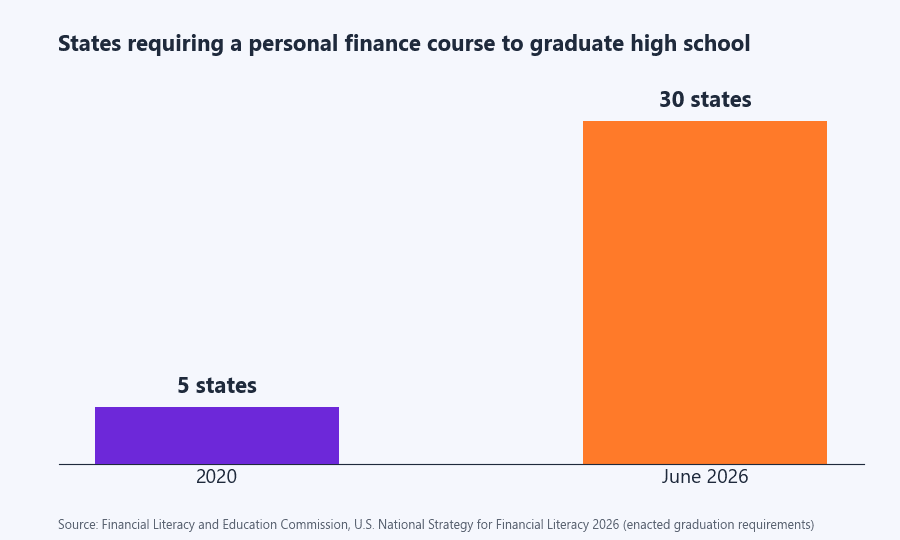
Basic financial literacy "has shown little improvement over the past decade and has declined particularly among younger Americans," the Treasury Secretary writes in the opening letter.[1] The share of U.S. adults answering at least 4 of 5 core questions correctly slipped from 34% in 2018 to 32% in the most recent readings, while, by the strategy's count, the number of states requiring a personal finance course to graduate rose from 5 in 2020 to 30 in June 2026.[1] An earlier note on this page examined that gap between required courses and measured knowledge.
What the federal government commits to is coordination: a new interagency working group for each priority, public meetings, and refreshed resources on MyMoney.gov.[1]
What it says works
For anyone building in this financial education market, the best practices list matters most. Financial education works, the strategy says, when it arrives at real decision points and uses "experiential, hands-on learning, as well as gamified and scenario-based activities."[1]
Its final best practice asks programs to be evaluated on outcomes, the test the Department of Education also set in August when it told states and districts to judge education technology by whether students actually learn.
Digital literacy and fraud education
Two of the four priorities describe the terrain teenagers already live in. The strategy defines digital financial literacy as "the knowledge, skills, and ability to make informed financial decisions regarding information provided through digital channels, and to safely use digital financial products and services."[1]
It notes sharp growth in mobile banking and apps like PayPal, Venmo, Cash App, and Zelle,[1] and reproduces Federal Reserve Bank of Philadelphia data showing 38% of adults ages 18 to 35 use social media for financial advice,[3] a problem this page has examined before.
The fourth priority, scams and fraud education, asks educators to teach consumers to recognize scams and to know where to report and recover.[1] The strategy cites Federal Trade Commission reports of more than $15.9 billion lost to fraud in 2025, and says FTC data show younger Americans are more likely to report losing money.[1]
Every common way of moving money carries some fraud risk, so scam education fits naturally inside lessons on how payments work. That's the approach FinBizify is built on: teaching how money moves through real companies and real numbers, with plans for teens to practice on simulated digital banking and brokerage screens and to learn fraud risk alongside each payment method, from checks and cards to apps like Zelle.
Other programs cover these topics too. Today the lessons teach through reading and testing, with watching, listening, and interacting planned so a teen can learn the same lesson in whichever way suits them. The content spans business, personal finance, and economics, so a payment, its fees, and its fraud risk can be learned in one place.
Sources
Financial Literacy and Education Commission, "U.S. National Strategy for Financial Literacy 2026," U.S. Department of the Treasury, October 2, 2026. https://www.mymoney.gov/sites/default/files/100/National-Strategy-Financial-Literacy-for-2026.pdf
"The Financial Literacy and Education Commission Releases the 2026 Update to the U.S. National Strategy for Financial Literacy," U.S. Department of the Treasury press release, October 2, 2026. https://home.treasury.gov/news/press-releases/sb0646
Tom Akana, Amber Lee, and Larry Santucci, "How Americans Use Social Media for Financial Advice," Federal Reserve Bank of Philadelphia, 2025. https://www.philadelphiafed.org/-/media/FRBP/Assets/Consumer-Finance/Reports/how-americans-use-social-media-for-financial-advice.pdf
FinBizify is building money education lessons that teenagers actually want to finish, taught through real companies and real dollar amounts.