Many online stock trades in the U.S. have carried a $0 commission since October 2019, when Charles Schwab, TD Ameritrade, E*Trade and Fidelity dropped their fees within ten days of each other.[1][2][3][4] The price reached zero in two steps. Online brokers in the 1990s made a trade cheaper by moving it onto the internet, and Robinhood's 2015 app made it free to the customer by getting paid by the trading firms that fill its customers' orders.[5] Schwab was an initial disrupter, and then Robinhood became Schwab's disrupter. Executing a trade still costs money. The commission fee line is simply where that cost stopped showing up.
The commission fee became something stock brokers could compete on back on May 1, 1975, when the SEC ended the fixed commission rates the industry had charged.[6] The internet did the next round of work. In 1997, Schwab's online customers paid $29.95 for a trade of up to 1,000 shares, while E*Trade charged a flat $14.95.[7] Prices kept sliding for two decades. By early 2017 Schwab's standard online stock trade cost $6.95, and that March it fell to $4.95.[8] Robinhood's own filing noted typical commissions before its 2015 launch were at "$8 to $10 per trade."[5]
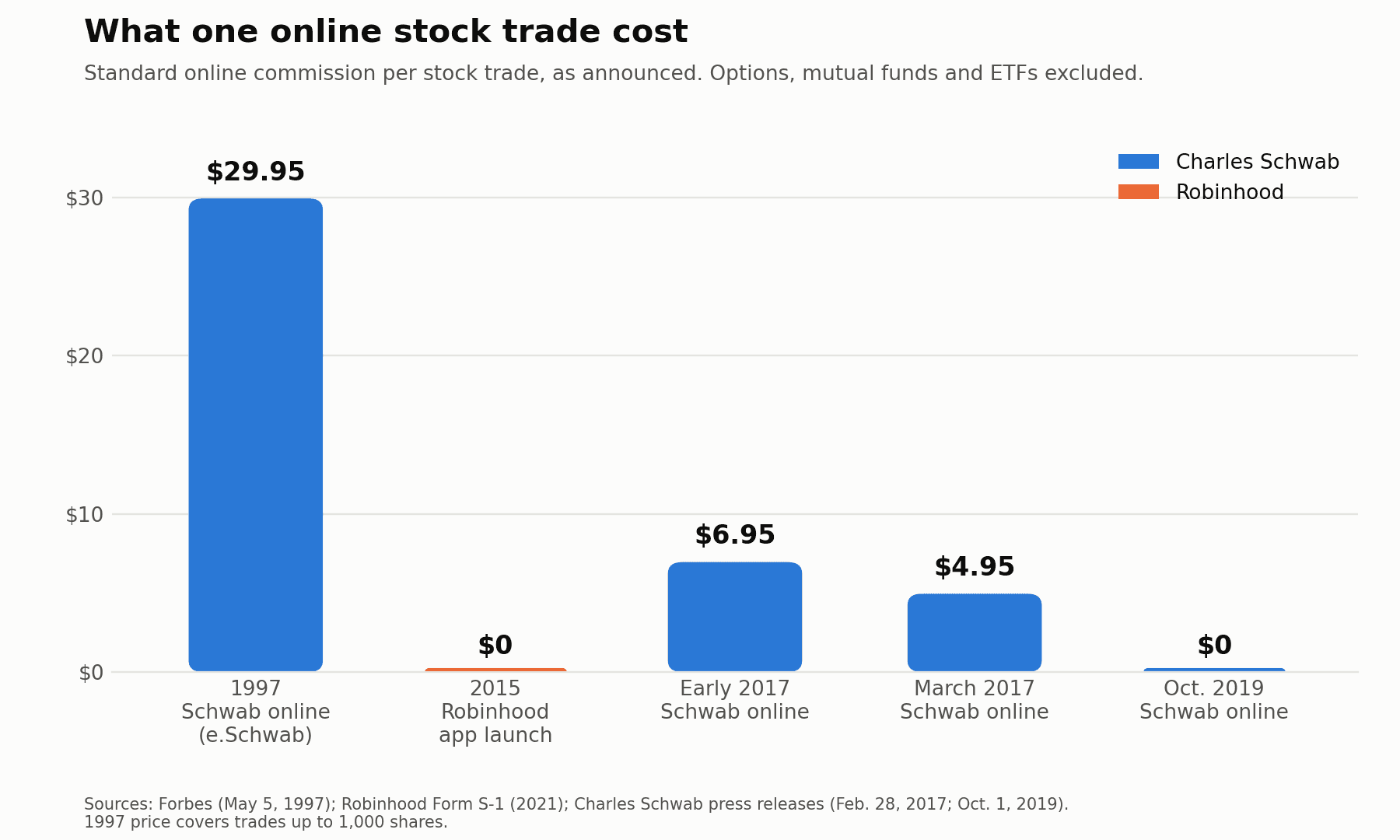
Robinhood, founded in 2013, launched its trading app in 2015 with no commission and no account minimum.[5] Its IPO prospectus (S-1 form) explains how the business works. When a customer buys a stock, Robinhood sends the order to a market maker, a trading firm that fills it, and the market maker pays Robinhood a fixed percentage of the bid-ask spread, the gap between the quoted buying and selling price.[5] That is called "payment for order flow", and together with similar rebates on cryptocurrency trades, were about 75% of Robinhood's 2020 revenue.[5]
The company says it "pioneered commission-free stock trading with no account minimums, which the rest of the industry emulated."[5] Four years after its launch, in late 2019, the largest incumbents had to match Robinhood's no-commission stock trades.[9]
The cost that replaced the stock trading commission is harder to see. Robinhood's prospectus notes that market makers often fill retail orders at better prices than the public quote.[5] Whether a $0 trade was a good deal still depends on the stock trade execution price, and that number doesn't appear as a separate fee.
The incumbents did not all fund zero commission fees the same way. Fidelity didn't accept payment for order flow, and it swept customers' uninvested cash into a higher-paying option by default.[4] Its president of personal investing, Kathleen Murphy, said firms that pay little on that cash have less "incentive to get their customers on a better investing path because they're making so much money on that idle cash."[4] That line is a competitor's sales pitch. It still names the right question.
The question matters most for the newest investors. Teen accounts at Schwab and Fidelity now let 13-to-17-year-olds place their own stock trades, buy fractional shares, and not pay a commission on stock trades. The toll on each trade fell from $29.95 at Schwab's 1997 online price to nothing over 20 years later.[7] For those young investors, a $0 commission is normal; they have never had to weigh a trade against its commission fee. Free trading opens the market to people investing as little as $20 at a time, and it gives today's teenagers far more opportunity to start early than the access and costs teenagers had a few decades ago.
The investor who knows the order itself is the product being sold can use that gain with open eyes, and can ask the same question of any free financial product: who is paying, and for what?
FinBizify teaches teenagers how real companies actually earn money, the understanding that turns a stock ticker back into a business with customers, costs and a way of getting paid. A brokerage's own revenue line is a good first one to learn to read.
Sources
"In Conjunction With Chuck Schwab's New Book 'Invested,' Schwab Removes the Final Pricing Barrier to Investing Online by Eliminating U.S. Stock, ETF and Options Commissions," Charles Schwab press release, Oct. 1, 2019. https://pressroom.aboutschwab.com/press-releases/press-release/2019/In-Conjunction-With-Chuck-Schwabs-New-Book-Invested-Schwab-Removes-the-Final-Pricing-Barrier-to-Investing-Online-by-Eliminating-U.S.-Stock-ETF-and-Options-Commissions/default.aspx
"TD Bank Group Comments on Expected Impact of TD Ameritrade Holding Corp.'s Decision to Eliminate Online Trading Commissions," TD Bank Group news release, Oct. 2, 2019, filed as Exhibit 99.1 with the SEC. https://www.sec.gov/Archives/edgar/data/947263/000127956919002030/ex991.htm
"#1 Digital Broker E*TRADE Announces $0 Base Rate Commissions for Online Stock, ETF, and Options Trades," E*TRADE Financial press release, Oct. 2, 2019, filed as Exhibit 99.1 to Form 8-K. https://www.sec.gov/Archives/edgar/data/1015780/000115752319002029/a52105029ex99_1.htm
Theresa W. Carey, "Fidelity Cuts Equity and Options Base Commissions to Zero," Investopedia, Oct. 10, 2019. https://www.investopedia.com/fidelity-cuts-equity-and-options-base-commissions-to-zero-4772738
Robinhood Markets, Inc., Form S-1 registration statement, July 1, 2021. https://www.sec.gov/Archives/edgar/data/1783879/000162828021013318/robinhoods-1.htm
Jason Zweig, "How May Day Remade Wall Street," The Wall Street Journal (Total Return), May 1, 2015. https://jasonzweig.com/how-may-day-remade-wall-street/
"Cyber-Schwab," Forbes, May 5, 1997. https://www.forbes.com/forbes/1997/0505/5909042a.html
"Schwab Reduces Trade Commissions to $4.95 and Lowers Per Contract Options Fee to $0.65," Charles Schwab press release, Feb. 28, 2017. https://pressroom.aboutschwab.com/press-releases/press-release/2017/Schwab-Reduces-Trade-Commissions-to-4.95-and-Lowers-Per-Contract-Options-Fee-to-0.65/default.aspx
"Fidelity follows rivals in cutting online trading commissions to zero," Reuters, Oct. 10, 2019. https://www.reuters.com/article/business/fidelity-follows-rivals-in-cutting-online-trading-commissions-to-zero-idUSKBN1WP220/
FinBizify is building money education lessons that teenagers actually want to finish, taught through real companies and real dollar amounts.