Americans rate schools at a record low. They rate critical thinking lowest of all.
Joe, founder of FinBizify
·
Americans' satisfaction with the quality of K-12 education fell to 32% in August 2026, the lowest reading in the 27 years Gallup has tracked it. [1] Asked what public schools do well, respondents put teaching critical thinking and problem-solving at the bottom of the list: 20% rate schools excellent or good at it, with preparing students for the world of work barely ahead at 21%. [1]
In the 27 years Gallup has asked, the number's lowest point had been 36%. [2] It last held a majority in 2019, at 51%. [1] What makes 2026 different is the agreement.
American political parties don't agree on much of anything these days, but they do agree in their dissatisfaction with K-12 education. Republicans hit their lowest point (20%) in 2023, and Democrats' satisfaction has fallen 19 points since 2024. [1]
In 2026, the groups sit at the bottom together: Democrats at 35% and independents at 32%, record lows of satisfaction for both, and Republicans even lower at 25%. [1] The consensus runs just as strong on what schools should teach: 88% of U.S. adults say their state should require a semester- or year-long financial education course for graduation [3], the requirement 39 states have adopted.
Between the 2019 majority (51% satisfaction overall) and the past several years after it sits the COVID pandemic. In spring 2020, nearly 93% of households with school-age children reported their children in some form of online or distance learning, by the Census Bureau's count. [4] For a full school year, and in some districts even longer than one year, lessons ran through the family's kitchen table, visible to any parent who cared to observe.
Gallup can't say how much of the souring traces to the 2020 and 2021 school years. The timing is still hard to ignore. The one stretch in 27 years when parents at large could watch instruction as it happened is also where the decline in satisfaction begins, and the parents watching closest cooled too: their rating of their own child's education fell to 66%, a record low as well. That same "own child's K-12 education" measure started at 83% in 1999 and had held at or above 70% every year since 2014. [1]
A parent who didn't like what they saw in their children's education often doesn't have much say in making any changes. About 15.5 million American teenagers attend public high schools, against roughly 1.4 million in private ones, per the most recent federal counts. [5] For those roughly 90% in the public-school majority, the curriculum is set by state standards and district adoption decisions. A dissatisfied parent's levers are a school-board ballot or a move to a different district.
The COVID pandemic handed families visibility into their children's classrooms. It did not hand them any new authority to help influence or change it.
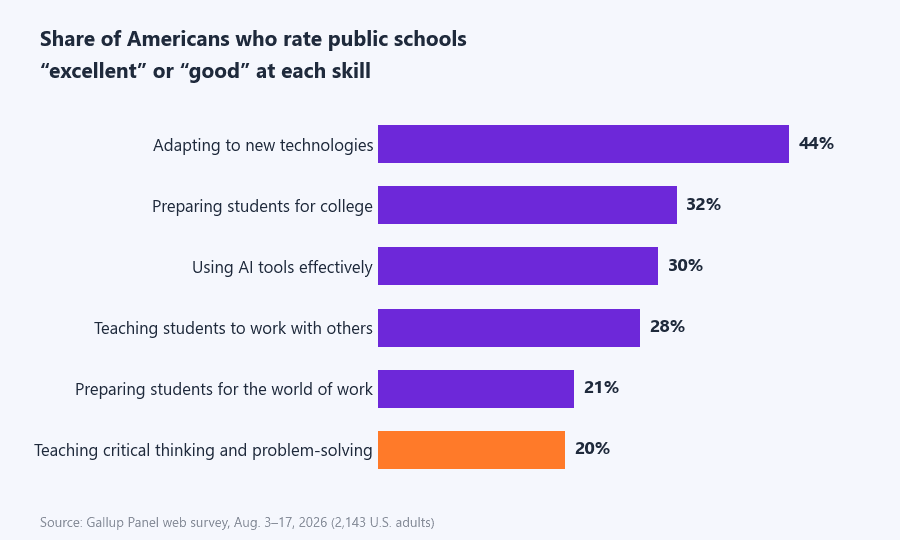
The skills rated lowest deserve the attention. Respondents give schools their best mark for adapting to new technologies, at 44%, and a passing nod on AI tools, at 30%. The two ratings at the bottom, readiness for the world of work and critical thinking, are the two that keep mattering after graduation. [1]
A startup investor and a university faculty committee landed on the same gap this year from opposite directions. Paul Graham wrote in August '26 that Y Combinator's partners "care a lot about the projects that applicants have worked on and not at all about their GPAs," and that what they look for is "the ability to build things and a habit of doing it." [6]
A Cornell faculty report reached a similar verdict the following month: education's real product is judgment, and it comes from working through real problems rather than performing for grades.
The public's two lowest ratings, readiness for work and critical thinking, were both described plainly by a leader in venture investing and a prominent Ivy League university.
Put together, the two findings say millions of parents saw the product up close, formed a changed view, and discovered their decision is often not theirs to make. Education a family buys directly reverses that arrangement. The parent can read the lessons themselves, hold them to the same outcomes test the Education Department set for edtech, and cancel the month the material stops earning its place, with no board meetings, no politicians' priorities, and no waiting for better options.
FinBizify is built for exactly that reading: parents see the same lessons their teen uses, taught through real companies and real numbers, and the family decides for itself, month by month, whether it counts as quality education. Based on the evidence above, parents are more than ready to make that call.
Sources
Megan Brenan, "Satisfaction With K-12 Education Hits New Low," Gallup, Sept. 7, 2026. https://news.gallup.com/poll/714017/satisfaction-education-hits-new-low.aspx
Megan Brenan, "K-12 Education Satisfaction in U.S. Ties Record Low," Gallup, Aug. 31, 2023. https://news.gallup.com/poll/510401/education-satisfaction-ties-record-low.aspx
"Poll: Most Adults Support Financial Education Mandates," National Endowment for Financial Education, April 25, 2022 (AmeriSpeak panel survey of 1,030 U.S. adults, March 17-21, 2022). https://nefe.org/news/2022/04/financial-education-mandates.aspx
Kevin McElrath, "Nearly 93% of Households With School-Age Children Report Some Form of Distance Learning During COVID-19," U.S. Census Bureau, Aug. 26, 2020. https://www.census.gov/library/stories/2020/08/schooling-during-the-covid-19-pandemic.html
"Fast Facts: Back-to-School Statistics," National Center for Education Statistics (public school enrollment, fall 2022; private school enrollment, fall 2021). https://nces.ed.gov/fastfacts/display.asp?id=372
Paul Graham, "How Universities Should Prepare Founders," paulgraham.com, August 2026. https://paulgraham.com/prepare.html
FinBizify is building money education lessons that teenagers actually want to finish, taught through real companies and real dollar amounts.